
Iconic buildings in Rotterdam
Stadhuis (city hall)
The city hall on Coolsingel was built between 1914 and 1920 and it was one of the few buildings in the city center that survived the bombing in May 1940. Queen Wilhelmina laid the first stone on July 15th, 1915. The Town Hall was built in neoRenaissance style with neo-Romanesque and neo-Byzantine influences.
The monument is symmetrical in design with the main entrance as the center point. The facade is richly decorated with various sculptures. Address: Coolsingel 40 (Google Maps)

Markthal
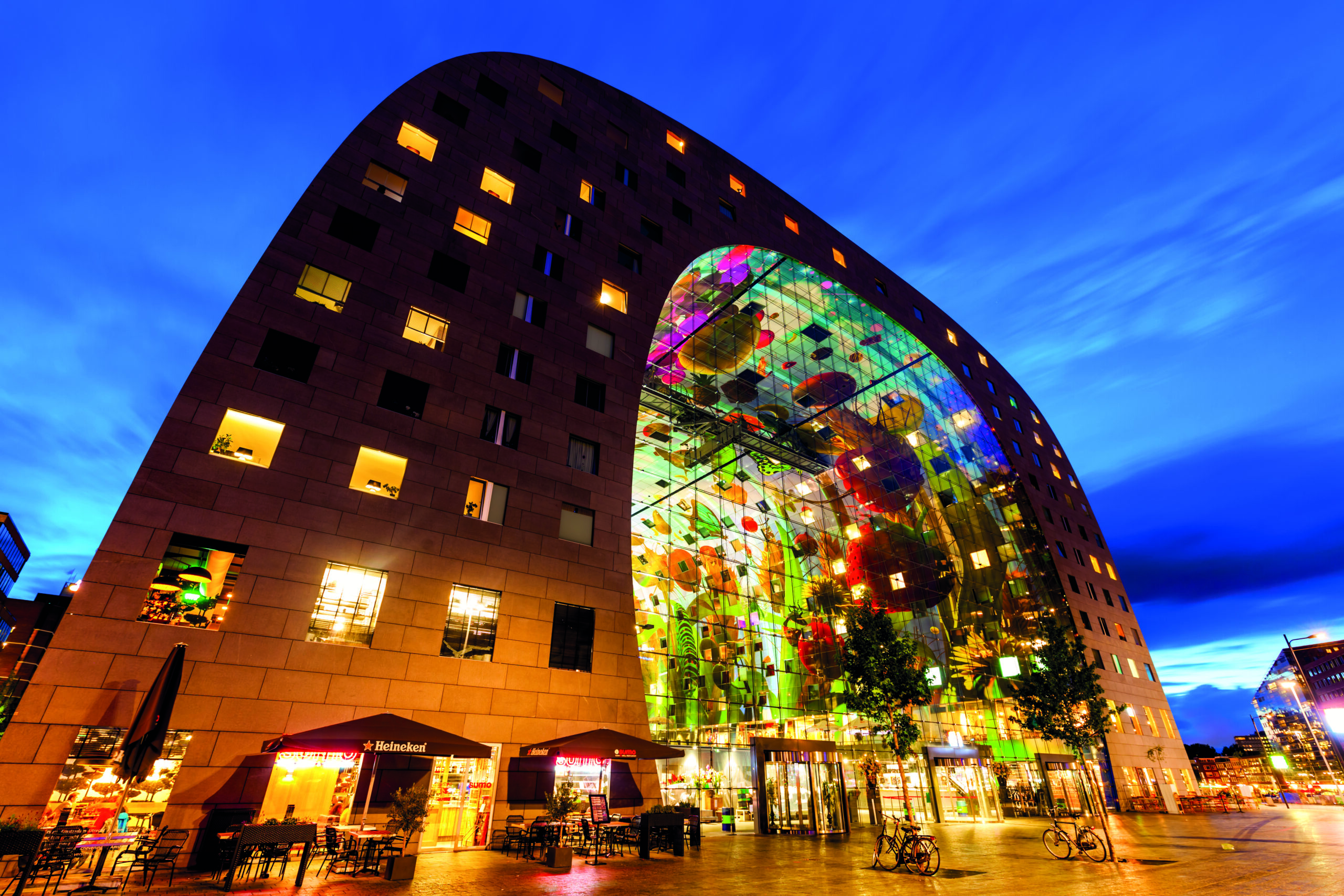
In 2014 Rotterdam become an icon richer with the opening of the fi rst covered fresh market in the Netherlands. The market located in the hall has about 100 stalls, food shops and various restaurants including a supermarket and four levels of parking. Wandering between the market stalls, you can look up and see the artwork “Horn of plenty” of Arno Coenen and Iris Roskam.
The horseshoe-shaped arch above the huge market fl oor contains rented and owned apartments. Address: Ds. Jan Scharpstraat 298 (Google Maps), www.markthal.nl
Rotterdam Central Station
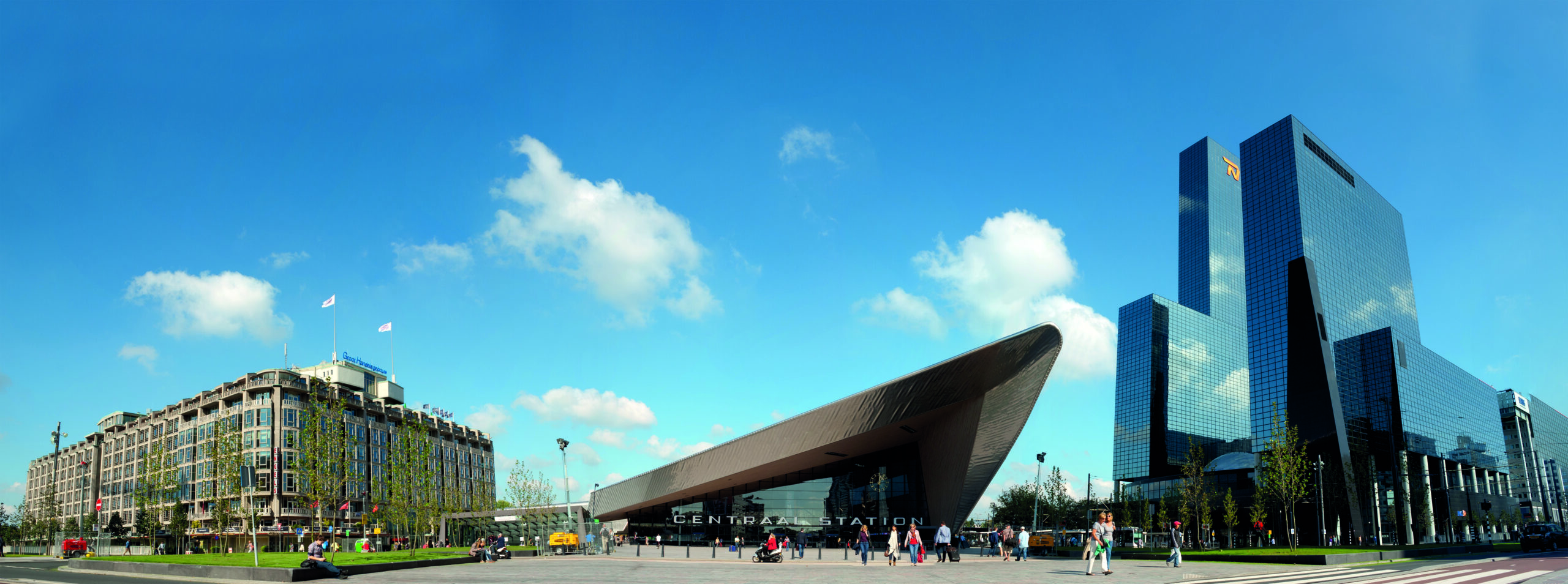
The current station building located on Stationsplein was officially reopened by King Willem Alexander on March 13, 2014. It is one of the greatest landmarks in Rotterdam. The distinctive shape of the new station forms the new entrance to the city.
The hall inside the building has a huge glass front with direct views of the city. The size and height of the hall provide ample space and light. The high-pitched roof and skylights make the most of the available daylight, creating a safe and pleasant space. Location: Google Maps
Groot Handelsgebouw
To the left of Rotterdam Central Station is the huge Groot Handelsgebouw, which is a national monument. The original spelling of the name revealed its origin as “The Wholesale Building”. In the early 21st century, the building’s name was changed slightly and placed in large letters over the building.
The Greatest Trade Building is an icon of reconstruction in post-war Netherlands. The Great Handelsgebouw was built shortly after the war to fill an acute shortage of commercial space, as many wholesale companies lost their business premises during the bombardment. Address: Stationsplein 45 (Google Maps)
Laurenskerk (Laurens Church)
This Gothic church is the only medieval relic in the city center of Rotterdam. The church was built between 1449 and 1525 and is thus the oldest building in Rotterdam. Originally, Laurenskerk was Roman Catholic but during the Protestant Reformation in 1572 the church was transformed into a Protestant church.
In the church you can see tombs of Dutch naval heroes. It is one of the few buildings that survived the bombing of Rotterdam during World War II. Address: Grotekerkplein 27 (Google Maps), www.laurenskerkrotterdam.nl

Cube houses (kubuswoningen)
The cube houses, built in the seventies are still one of the favorite places for foreign tourists. They are also called pole houses or tree houses due to the fact that they are shaped like a tilted cube on a pole. Address: Overblaak 70 (Google Maps), www.kubuswoning.nl

De Rotterdam
A visit to Rotterdam would not be complete without a visit to the building De Rotterdam, one of the city’s architectural icons. Together, the three interconnected towers which reach almost 150 meters form a ‘vertical city’ with luxury apartments, a fourstar hotel, offi ces, shops, hospitality, fi tness and parking.
The building lies on a piece of land the size of a football fi eld and was made to be extremely sustainable. The name refers to the steamship the ss Rotterdam, which used to depart for New York, and for the comfort of travelers, also needed to accommodate many functions. Address: Wilhelminakade 139 (Google Maps)

The Distilleerketel
A special attraction in Delfshaven is the Moutmolen, also known as the Distilleerketel (Stills). In the past there were fi ve malt mills in Delfshaven, of which the Distilleerketel is the only one left. But it is amazing that it still exists because in 1940 the mill was largely destroyed by f i re.
It wasn’t rebuilt for another 44 years, a few meters from the original spot. Nowadays you can get a nice tour through the mill and even see it in operation! Address: Voorhaven 210 (Google Maps)

De Hef
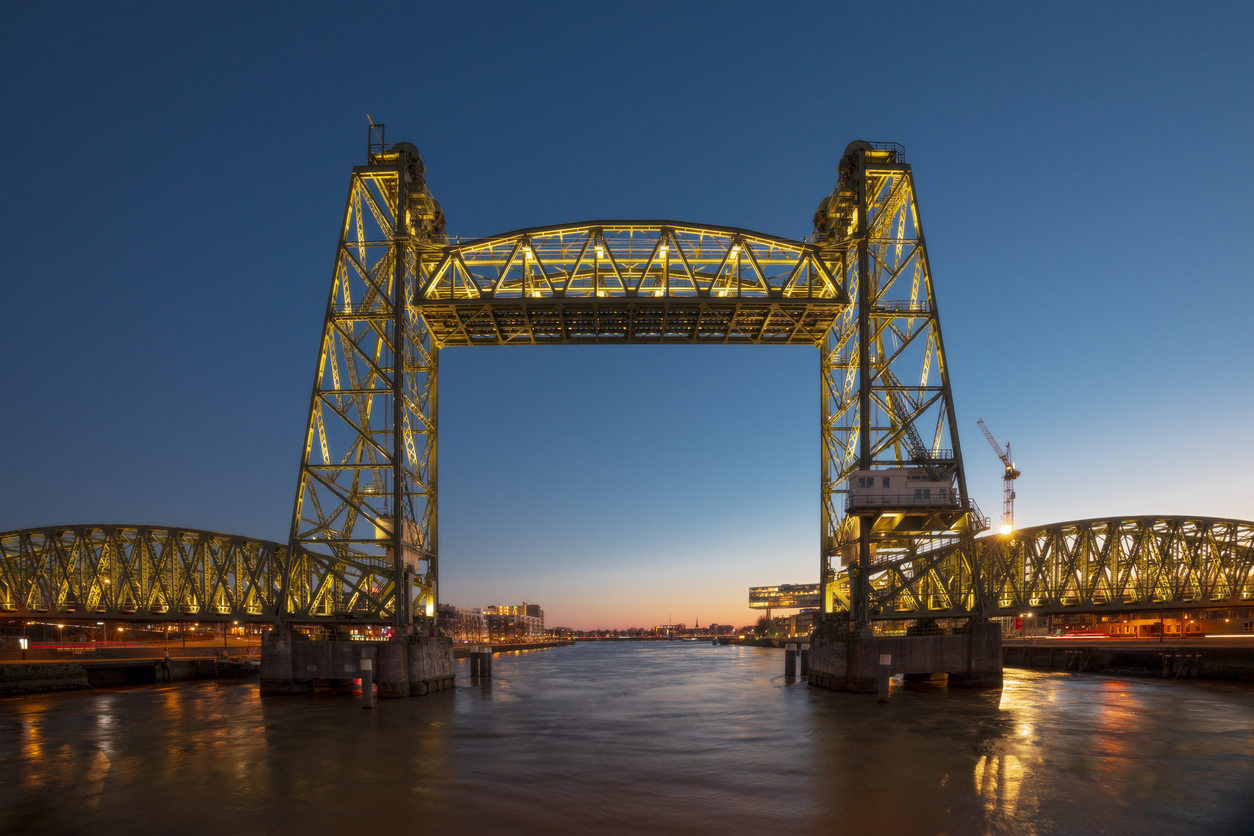
The Koningshavenbrug is also known as “De Hef”. The bridge was first used in 1878. Nowadays it’s no more than a monument. Next to the Koningshavenbrug lies a second bridge, the Koninginnebrug (Queen’s Bridge), which was put into service in 1929.
The Koninginnebrug is a bascule bridge and it lies across the Koningshaven. The bridge provides access to the Noordereiland. Google Maps
Hotel New York
Located in the former headquarters of the Holland America Line. This is the place where long ago thousands of emigrants, full of hope of a better life, left for North America. The iconic building has been glittering on the Kop van Zuid since 1901. It’s a building with a very important history. Address: Koninginnenhoofd 1 (Google Maps), www.hotelnewyork.com
The White House
The Witte Huis (White House) is the first skyscraper in Europe. This 43-meter-high building was built in 1898 and for a long time it was the highest offi ce building in Europe. The developers of the White House were inspired by the Art Nouveau style of skyscrapers in Manhattan while visiting New York.
Visitors to the Witte Huis could take the elevator to the viewing platform on top of the building, which was a new concept at the time. Nowadays, there is a nice cafe on the ground fl oor of the Witte Huis, perfect for a drink and a snack. Address: Wijnhaven 3a (Google Maps)

Van Nelle Factory
The Van Nelle Factory is listed as a UNESCO World Heritage Site. Founded around 1925 as a factory for coffee, tea and tobacco, this building has had a significant impact on the evolution of modern architecture in Europe.
Architect Leendert van der Vlugt designed a structure in which light, air and space are the key elements. The result is the magnificent Van Nelle Factory, located in Rotterdam’s Spaanse Polder. Address: Van Nelleweg 1 (Google Maps), www.vannellefabriekrotterdam.com